Wednesday, March 11, 2020

This Is Why You Follow Sports

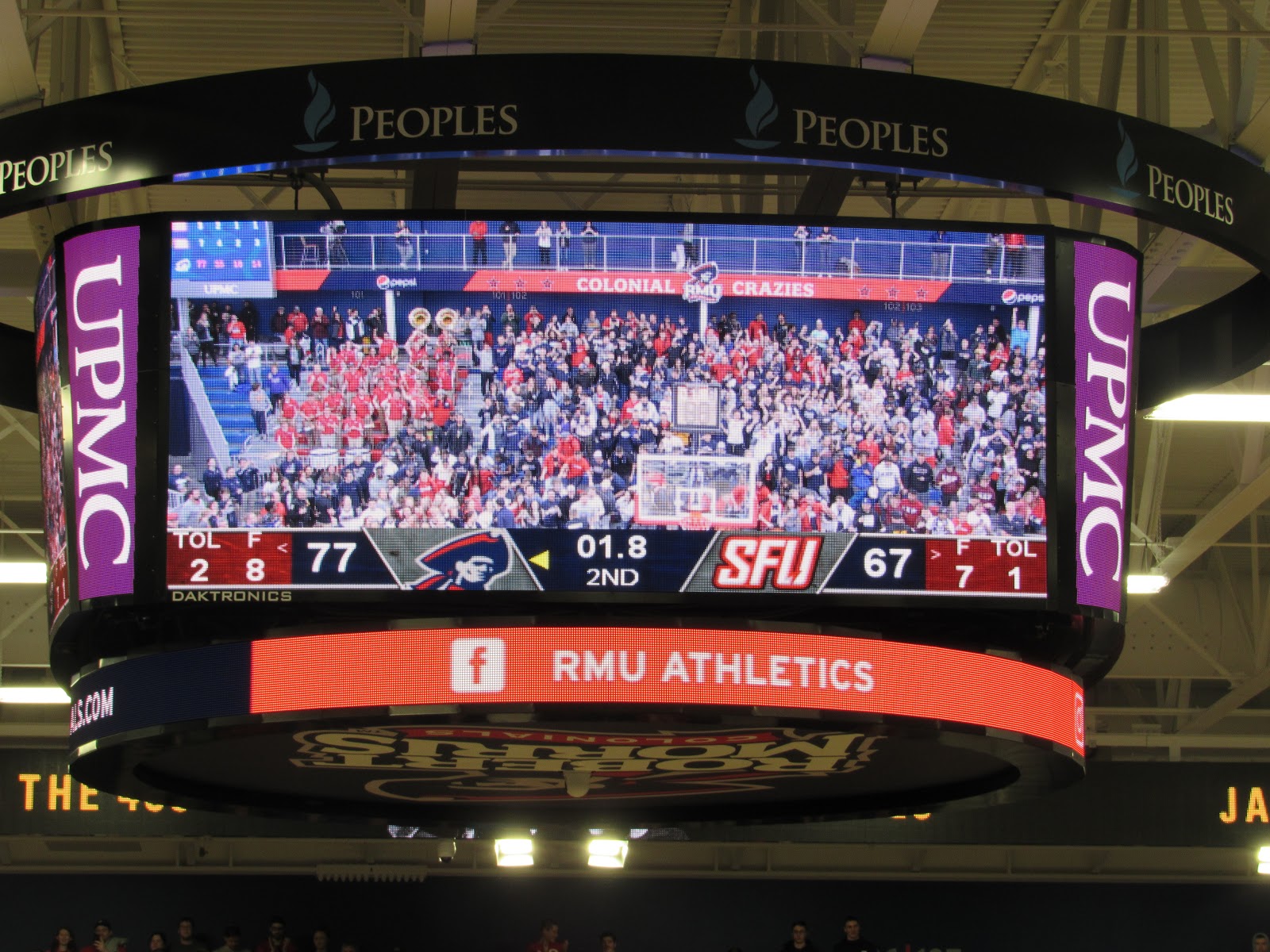
On more than one occasion over the last ten plus years of writing The Grandstander, I have used the expression "this is why you follow sports" when writing of one especially thrilling game or contest.  Last night Marilyn and I experienced such a night when we headed out to our alma mater, Robert Morris University, to watch the Colonials take on St. Francis in the Northeast Conference Men's Basketball Tournament Championship Game.


As is known by now, RMU won the game 77-67 (and the game wasn't as close as that score indicated) and secured an automatic bid to the NCAA Men's Basketball Tournament. They will no doubt be a very low seed and will lose convincingly to one of the NCAA blue bloods with a #1 or #2 seed, but no matter.  When you play in a mid-major conference like the NEC, last night is what you play for, and all of the elements were in place for just a terrific night.  It was the culmination of the first season the RMU's beautiful new Events Center, they were playing a team with whom they split the season series, and the place was sold out - 3,800 people and a packed student section.  The joint was loud and raucous and it was just a joyous event.

I have been lucky in my life.  I have been to NFL playoff games and World Series games and Stanley Cup Playoff games and NCAA playoff games.  I've been to US Opens and the Masters.  But last night a game between two small colleges in a minor league NCAA conference gave me a sporting moment as pleasurable and as fun as anything that I have ever attended.

It's why you follow sports.


Tuesday, March 10, 2020

Major League Soccer, aka the MLS


Yes, you read that headline correctly -  The Grandstander is about to offer a commentary on Professional Soccer in America, specifically, the MLS (Major League Soccer).  I will take no judgement as to the quality of play of the teams and players, because, of course, I have no qualifications to do so.  No, what is prompting this is a comment made by the commissioner of MLS, Don Garber, who recently said that in the next twenty years, MLS will have surpassed Major League Baseball in popularity.

Many people scoffed at this, but I did not.  If you read The Grandstander regularly, you know that I have made many posts regarding the need for MLB to make changes, to alter the pace of play and "get with it" to adapt to tastes of 21st century audiences who are finding baseball becoming more and more unwatchable as World Series games approach four hours in length (not to mention meaningless games played in August and September).  The cluelessness of both MLB Management and Players Union in their willingness to address these matters continues to contribute to the problem.  This will result in games being played before smaller and smaller crowds and having lesser and lesser interest among the public as the Baby Boom generation continues to age and, eventually, die off.  As an example, my older brother tells me that his four grandsons, who range in age from 18 to 25, can name you any number of soccer players in the English Premier League, but would be hard pressed to name a half dozen players from the Washington Nationals, the current World Series champions.

So, what about Mr. Garber's claim?  I went to Wikipedia (so we all know that this must be true, right?) to check on attendance figures for the MLS for its most recently completed season, 2019:

Total Attendance (24 teams, 408 games) - 8,676,109
Average Attendance per Game -21,305
Highest Average Attendance - Atlanta 52,510
Lowest Average Attendance - Chicago 12,324

In terms of Attendance As a Percentage of Capacity:
  • 100% or more - 6 teams
  • 90% to 99% - 3 teams
  • 80% to 89% - 7 teams
  • 70% to 79% - 5 teams
  • 60% to 69% - 3 teams
(Curiously, the three lowest Percent of Capacity teams are two teams in New York City and one team in Chicago.  Not sure what that tells us.)

Major League Baseball, by contrast, had teams whose average attendance ranged from 10,016 (Miami Marlins) to 49,066 (LA Dodgers).  The Dodgers played to an 87% capacity at Dodger Stadium last year; the Marlins at 27% capacity.  Some other figures of interest: Red Sox at 96% capacity, Yankees at 86% capacity, and, of local interest, the Pirates at 48% capacity (18,413/game).

I am sure that somewhere out there one can find a decennial breakdown of percentage of capacity for the 30 MLB teams.  I quit looking for it after awhile, and I didn't want to take the time of compiling this on a team-by-team basis.  Perhaps another time.

And just to carry this out a bit further, I did a comparison of National Hockey League attendance for the 2018-19 season.  average attendance ranged from 12,442 (NY Islanders) to 21,399 (Chicago Black Hawks).  In terms of percentage of capacity, here is how it broke down for the NHL:
  • 100% or more - 10 teams
  • 90% to 99% - 16 teams
  • 80% to 89% - 1 team
  • 70% to 79% - 4 teams
Locally, the Penguins averaged 18,565/game last year, good for 101% of capacity.

I'm too lazy to look up similar figures for the NBA.  Feel free to do so on your own.

Conclusions?  Well, I am not claiming to have made an authoritative, all-inclusive analysis of attendance trends all across major league sports in America, but I am willing to grant that the MLS Commissioner's statement cannot be dismissed out of hand.  There are lots and lots of other factors involved (eg, what are the MLS TV ratings compared to other sports?), and we all know that numbers can be sliced and diced ("figures lie and liars figure", right?) to come up with any conclusion that you might want to make, but one conclusion that I can make is that the MLS should probably be considered a major sport in America.  I won't be around in 2040 to see if Mr. Garber's prediction proves to be accurate, but I wouldn't bet against it.

Saturday, March 7, 2020

Old Movie Time - "The Lady Vanishes" (1938)

In a random post that I recently made on a Facebook movie themed group page, I asked people to name their Top Five Alfred Hitchcock Movies.  For the record, mine were, alphabetically, North By Northwest, Notorious, Psycho, Rear Window, and Vertigo.  A Facebook pal of mine, Bob Cassinelli from Illinois, told me that his list would be identical to mine "if I took out Vertigo and substituted The Lady Vanishes."  As it happens, I had never seen "The Lady Vanishes" so last night, I rectified that oversight and, thanks to the magic of streaming, I watched this 1938 Alfred Hitchcock classic.

"The Lady Vanishes" was one of the last films that Hitchcock made in Great Britain before he left for Hollywood for bigger budgets and even greater fame.  It has all of the Hitchcock trademarks:  a long opening tracking shot, a protagonist who is stating a fact that she knows is true, the audience knows is true, but no one else believes her, a Hitchcock cameo appearance, and, of course, a Maguffin around which the whole sequence of events revolve, but is essentially inconsequential to the story.

It opens in a hotel in a train station somewhere in the Balkans where an avalanche has delayed the train scheduled to head west and eventually to England.  Because of the delay, all passengers have to stay overnight at the hotel, and this enables Hitchcock to introduce the cast of characters....Iris Henderson (Margaret Lockwood), a young Englishwoman just completing a tour of Europe where she seemed to sow some wild oats with two girlfriends and is now headed back to England to marry and settle down with some dreadfully dull Englishman....Gilbert Redman (Michael Redgrave), a somewhat flighty musician who is writing a book about obscure European folk music....Miss Froy (Dame May Whitty), a elderly English governess....Mr. and "Mrs." Todhunter, and adulterous couple headed back home....Messrs. Caldicott and Charters, two straight-out-of-central-casting oblivious Englishmen who want nothing but to get back home for some important cricket matches.  There are others as well who will play significant roles in the adventure that begins the next morning when they all finally board the train and head for Jolly Old England.

Redgrave, Whitty, Lockwood

Iris, who received a nasty bump on the noggin just before boarding, becomes friendly with Mrs. Froy while sharing a compartment with her and four other passengers and has a spot of tea with her in the club car.  When they return to their compartment, Iris falls asleep, and when she awakens, Mrs Froy is gone, and not only doesn't anyone know where she is, everybody insists that there is, and never was, such a lady.  That bump on the head has surely caused Iris to imagine the entire thing, and she had better consult with a doctor when she gets home, or, better yet, consult with Dr. Hartz, an eminent "brain doctor" who just happens to be on the same train.

Iris then takes up with Gilbert, whom she took an immediate disliking to the previous night in the hotel, to find Mrs. Froy, and, not incidentally, find out just what in the bloody hell is going on here.  Most of the movie takes place within the confines of a moving train (something that we would see Hitchcock employ later on in Strangers On A Train, Shadow of a Doubt, and North by Northwest), and that adds to the suspense.  Did I mention that it's 1938 and that we are in Europe, albeit in a fictional country?  Some allusions are made to just what is taking place in Europe at that time, so that means that there must be SPIES involved in all of this right?  Ahh, that's the Maguffin that I mentioned above.  Oh, and what about that marriage between Iris and her stuffy boring English gentleman?  You are going to have to watch the movie yourself to find that out.

The story does indeed resolve itself, and if you are like I was and have never seen this movie, I certainly won't spoil it for you, but it is quite a good one, and it is one, I suspect, that I will come to enjoy even more upon repeated viewings.  It doesn't crack my Hitchcock Top Five, but I will give it three Stars on The Grandstander's Four Star scale, and I again thank Bob Cassinelli for prompting me to seek it out and watch it.

Some other observations....

Margaret Lockwood
  • I was completely unfamiliar with Margaret Lockwood, but after watching, I did a little research.  She was only 21 years old when she made this film.  She was quite pretty and a very smart and spunky Hitchcock heroine, not at all  the cool icy blonde that became such a Hitchcock trademark.
  • She moved on to Hollywood and found little success on this side of the Atlantic, so she quickly returned to Great Britain, and made a career playing mostly vampy, "bad girl" roles.    She died in 1990 at the age of 73.
  • The characters of Caldicott and Charters, provided a great bit of comic relief to "The Lady Vanishes", yet still played a significant role in the story.  They were played by actors Naunton Wayne and Basil Radford, and their characters were so well received by the movie going public, that they were teamed up by British filmmakers and made ten other movies together over the course of their careers.  Not sure if they were on the same level of Hope and Crosby, but jolly good for them.
  • Dame May Whitty.  Whenever I hear her name I think of Johnny Carson's "Mighty Carson Art Players" bit when he played Art Fern doing the Tea Time Movies.  He would always list preposterously named movies that starred a string of actors whose names rhymed with each other.  Invariably, some of the movies would always star "Dame May Whitty and Conway Twitty."
  • "The Lady Vanishes" has been remade at least three times that I could find.  The most interesting bit of casting was a 1979 American version that starred Elliott Gould, Cybill Shepard, and Angela Lansbury.
  • Bob Cassinelli, whose comment inspired this post, attended Northern Illinois University.  At first, I thought this was pretty cool because that's where Tony Romo went.  WRONG!  After double checking, I see that Romo went to Eastern Illinois.  However, Bob's alma mater produced some other famous fellow alums...Dennis Hastert, ex-Speaker of the U.S. House of Representatives,  who ended up in the slammer for doing some very unspeakable things, Dan Castellaneta who provides the voice of Homer Simpson, and perhaps most significant of all for movie fans, actress Cindy Morgan, who played Lacy Underall, the sexy niece of Judge Smails in "Caddyshack."  Now THAT is brushing with greatness!


Thursday, February 27, 2020

"Downhill"


While we have seen a number of movies so far in 2020, today we took in our first movie that is an actual 2020 release.  The movie is "Downhill" directed by Nat Faxon and Jim Rush and starring Julie Louis-Dreyfuss and Will Ferrell.  With these stars you might expect to be seeing a goofy comedy, but this movie, while it has some moments of humor in it, is no comedy.

Billie and Pete are on an Austrian ski vacation with their two sons.  While dining at an outdoor lodge at the resort, an avalanche occurs.  Billie grabs on to their two sons and prepares for the worst.  Pete grabs his cell phone and runs away.  The moment passes, everyone is okay, physically, but the relationship between Pete and his family is changed dramatically and, perhaps, irrevocably.  While the mountain scenery is fairly spectacular, watching how this all plays out is the stuff of a serious stage play.


It is odd to see actors like Louis-Dreyfuss and Ferrell depart from their well established personas and take on roles like this, and they both pull it off.  Louis-Dreyfus is especially good in her role.  Actors sometime get typecast, Ferrell, especially, but it's enjoyable to see them stretch themselves out in roles such as these and carry them off.

Like a lot of movies that get released in January and February, this one will probably be pretty much forgotten as the year rolls along.  Today was the last day that it will be at our local multiplex, and it will probably now be difficult to find until it gets released to the streaming services and DVD shelves.  Too bad.

Both Marilyn and I liked it, and The Grandstander gives it Two and One-Half Stars.


Wednesday, February 26, 2020

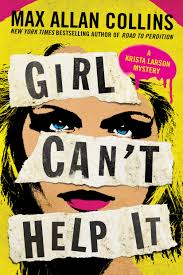
"Girl Can't Help It" by Max Allan Collins

Back in the early 1980's, the rock band Hot Rod & The Pistons, out of Galena, Illinois, were the hottest things on the the western Illinois/eastern Iowa rock and roll circuit, and they even became a one hit wonder nationally with a cover version of "The Girl Can't Help It", which was the title song from a 1956 movie that starred Jayne Mansfield. As it usually happens, the band broke up, one member passed away, and for the most part, the guys got on with their lives.  However, it is now 2020, and Hot Rod & The Pistons are about to be inducted into the Iowa Rock and Roll Hall of Fame, and, yes, there really is such an institution.  Their induction into the Hall is marred when one of the members dies suddenly of an apparent heart attack, and a few months later, just as a reconstituted version of the The Pistons is about to embark on a summer reunion tour, another member commits suicide.

This is the premise for "Girl Can't Help It", the second in a new series by one of my favorite mystery/thriller/detective authors, Max Allan Collins, that features Krista Larson, the 29 year old Chief of Police of Galena, Illinois, the "youngest female police chief in the United States."  The reader, of course, knows that the former bandmates were actually murdered.  The motive for the killings is known early on, but the identity of  the murderer is not, and that makes for nifty little whodunit for Krista - and the reader - to solve.

Author Collins, 72, is a native of Iowa and has played in rock bands for most of his life.  He actually IS a member of the Iowa Rock & Roll Hall of Fame!  As such, he brings to this novel a bunch of delightful kitschy pop cultural references to the American rock & roll scene from the 1950's through the 1980's, when The Pistons were the darling of the Iowa rock scene.  He also wonderfully evokes the tourist town of Galena.  I have never been there, of course, but I have been in many other similar places in my life, and I can perfectly  picture the restaurants, parks, bars, and touristy junk stores of the town that he describes.

To assist her in solving the crime, if indeed there really has been a crime committed, Krista enlists the aide of her father, Keith, a widowed and retired police detective.  As we learned in the first novel of the series, Krista lives in and now owns the house in which she grew up, but she has invited her father to move back in with her when she worried that he was experiencing depression over the recent death of his wife and her mother.  As was the case in the first book, Keith, who had some ties to Hot Rod & The Pistons back in the day,  is  enlisted by Krista on  pro bono basis to help her and the Galena PD get to the bottom of things.

It is apparent that while Collins calls these books "Krista Larson Mysteries", it is really going to be a "Krista and Keith" series of books.  Personally, I would like to see more of Krista and less of Keith, but this won't stop me from reading future novels in the series.  And as a humorous sidebar, Collins touches upon the somewhat delicate issues of how a daughter, who is just getting involved in a romantic relationship, has to deal with her widowed Dad who is now dipping his toes into the dating/relationship waters once again himself.  With both of them living in the same house, no less!

Like I said earlier, the murderer is not revealed as the crimes are committed, but it is apparent that it is someone that everyone, not only in the band, but in Galena, too, knows.  I figured it out about about halfway through the book, but that doesn't lessen the fun of reading how Krista and Keith resolve the matter.  Also, while I figured out the WHO, I had no clue as to what the eventual denouement would be, and it was both surprising and satisfying.  All I will say is that the lesson of how sins of the past can come back to haunt you is the very effective moral of "Girl Can't Help It."

I give it Three Stars on The Grandstander's reliable Four Star scale.  I will anxiously await the next Krista Larson adventure, as I also await the release, later this Spring, of Collins' "Do No Harm", a new Nate Heller mystery wherein relentless Private Eye Heller tackles the Sam Sheppard case.

And if this post piques your interest in the previous Krista Larson story, "Girl Most Likely", I will refer you to this:
Sunday, February 23, 2020

The Kirbys, Father and Son

Okay, this is going to be one of those esoteric and weird posts that will probably be of no interest to anyone but me, but here goes.....

I was on a kick last week of watching old episodes of "Columbo."  Watched all six episodes of Season Four, which ran in the 1974-75 television year.  I always enjoyed "Columbo", and it was fun watching people like Robert Conrad, Robert Vaughn, and George Hamilton overact and smugly look down upon the rumpled Lt. Columbo, right up until Peter Falk slaps the handcuffs on them.  Also, nothing like those mid-seventies fashions - tight bell bottom slacks and rayon shirts with fly-away collars, not to mention big hair on the ladies - to give you a laugh or two.

Bruno Kirby
"B. Kirby Jr."
1949-2006

Anyway, an episode called "By Dawn's Early Light" featured a very young Bruno Kirby as a teenaged military cadet.  You remember him, right?  He portrayed young Peter Clemenza in "Godfather - Part II" in 1975, when he was billed as "B. Kirby Jr.", as he was in this particular Columbo episode.  He appeared in a couple of Billy Crystal's 1980's comedies, "City Slickers" and "When Harry Met Sally" when he was billed as "Bruno Kirby." At other points in his career, he was sometimes billed as "Bruno Kirby Jr."  From 1971 through 2006 he amassed 69 credits on television and in the movies. He was a most familiar face in those years, right up until his death from leukemia in 2006 at the way too young age of 57.  So it was no surprise when he jumped right off the screen in this bit part in the Columbo episode.  (In fact, seeing actors in bit parts in shows like this who later went on to big things is one of the fun parts of watching them.)

Also appearing in "By Dawn's Early Light" as Sgt. George Kramer, one of the plainclothes cops tailing after Lt. Columbo, was actor Bruce Kirby.

Bruce Kirby
1928 - ____

Bruce Kirby was and is - he's still with us and will turn 92 in 2020 - one of those character actors that you have seen a million times on television and in movies over the years.  IMDB lists 143 acting credits for him stretching from 1955 through 2006.  They included regular supporting roles on shows such as Car 54, Where Are You?, Kojak, and L.A. Law.  He appeared in nine separate episodes of Columbo.  Look him up in IMDB, and you will see the names of dozens of television shows, some long forgotten, some memorable, in which he appeared.

Well, it turns out that he is the father of Bruno Kirby, the "Senior" to Bruno's "Junior."  He was born in 1928 as Bruno Quidaciolu, and became "Bruce Kirby" when he went into the acting biz.  Fun Fact: In Rob Reiner's 1986 movie "Stand By Me", he played a character named "Mr. Quidaciolu."  In one of the Columbo episodes that I watched, his Sgt. Kramer had a fairly large speaking part, and if you might not have seen a physical resemblance between father and son, you could definitely hear a vocal and speech pattern in Bruce's voice that were definitely passed on to his son, Bruno.

Like I said, this is just one of those things that I find interesting and intriguing.

Friday, February 21, 2020

To Absent Friends - Dan Radakovich

Dan Radakovich
1935-2020
"Bad Rad"

The death of someone so closely associated with the Super Bowl Steelers of the 1970's is always worth noting, so today we bid a melancholy happy trails to Dan Radakovich, a defensive and offensive line coach with Chuck Noll's Steelers for the first two of those four Super Bowl triumphs.  Radakovich died yesterday at the age of 84.

"Bad Rad" was also an integral part of the establishment of the football program at Robert Morris University, serving as Joe Walton's defensive guru for the initial years of that program.  He is a member of the RMU Sports Hall of Fame.

No one defines the definition of a football coaching "lifer" than did Radakovich.  In addition to his time with the Steelers and Robert Morris, his career included coaching stints at Penn State (where he played), the University of Cincinnati, Colorado, North Carolina State, and in the NFL with the 49'ers, Rams, Broncos, Vikings, Jets, and Browns, as well as stint with the London Monarchs in the World League of American Football.  

RIP Dan "Bad Rad" Radakovich.