Saturday, March 21, 2020

Reflections on Isolation, Week 1

Random thoughts after a surreal week......

As readers know, I love a good cliche, especially when writing about sports, but I generally eschew them, or try to, in normal conversation, but I am going to use one here.  New Normal.  Don't like that one, but it is one that Marilyn and I have been faced with on more than one occasion of late, and this past week of isolation, quasi-quarentining, and social distancing (the latest new buzzword)  has been surreal to say the least.

Hey, we're retired, so it's not like we have a job to go to, or classes to attend, or kids to raise, so what else are we going to do all day, right?  However, when you are, if not ordered to do so, then strongly advised to stay home and do nothing, you find that it's HARD HAVING NOTHING TO DO!!!

So far, this has been our week....I have finished two books and have started on a third, Marilyn has read at least that many, we are halfway through a 500 piece jigsaw puzzle (pictures to follow upon completion), and have brought out the board games (Parcheesi and Poker's Wild so far).  Lots of naps, never a bad thing, but strangely enough, not a lot of television watching.  I did watch a 1971 Lt. Columbo TV movie called "Ransom for a Dead Man" (Lee Grant was the special guest killer.  Man, she was pretty!), and on Monday I watch four episodes of "Family Guy" on TBS.  "Family Guy" is rude, lewd, juvenile, and totally tasteless, but,  God help me, I can't help but laugh uproariously every time I watch it.  I'm not proud of that, but there you are.

********
Sports are gone.  No  sports to watch.  While I didn't often plant myself in front of the tube and watch four solid hours of sports every night (with some exceptions, of course), it's remarkable how much you miss by not being able to watch a couple of innings of a baseball game, or a half hour or so of a basketball or hockey game, or spend a Sunday afternoon watching a golf tournament.  Life's pleasures are often taken for granted, and we are certainly missing those sporting pleasures now.

I did watch, and you read about it here a few days ago, a DVD of the complete telecast of the Steelers win in Super Bowl XIII in 1979.  That was fun, and there are five other of those games that I can watch at some point in the days ahead.

********
There are two sports in the news.  One is the National Football League, so far unaffected by COVID-19 postponements.  The NFL "year" began this past week with a splash of free agent signings.  The biggest of which was the severance of the twenty year connection between Tom Brady and the New England Patriots, and his signing with the Tampa Bay Buccaneers.  It is almost inconceivable to imagine Brady in anything but a Patriots uniform, and the odds are that this second act will not end well for him.  True, an aged Peyton Manning left Indy for Denver, and took the Broncos to two Super Bowls, winning one of them, but the odds are that the many tropes posted in the last week (Willie Mays as a Met, Johnny Unitas as a Charger, Franco Harris as a Seahawk, the list goes on) will be the more likely end for Brady, the G.O.A.T.  

A guy like Brady deserves the right to call his own shots as to when and how to end his career, so good luck to him.

Also, we shall now get to see how great a coach Bill Belichick is without Tom Brady as his quarterback. If I had to bet, I would bet that Belichick will prosper more than will Brady in the years ahead, but we shall see.

********
In the other sport in the news, the money grubbers at that comprise the International Olympic Committee are continuing to insist that, despite a worldwide pandemic, the Tokyo Summer Games will go on as scheduled come July 24.   Today I read that the USA Swimming, the governing body of that sport in the United States, has called for a postponement of the games.  That appears to be the first significant fissure in the dam that is the IOC, so, again, we shall see.  As my pal Matthew stated in a Facebook post the other day, he often has a hard time deciding who he hates more, the NCAA, the IOC, or FIFA.  Today, the IOC is in the lead.

********

I close this post with a picture of a statue of Winston Churchill that stands in Parliament Square in London.  I took this photo when we visited that city last year.  Why am I doing this?  Well, I just finished Erik Larson's terrific new book, "The Splendid and The Vile" (reviewed on this Blog earlier in the week), that detailed Churchill's first year as Prime Minister, a year when Great Britain was at war with Hitler's Germany, and the city of London and all of Britain was being bombed on a nightly basis by the Luftwaffe.  To read how British citizens lived through and survived that horror, and to read that one of the reasons that they were able to come through all of that was the extraordinary leadership of Winston Churchill, offers a large dose of inspiration and perspective.  It did for me, anyway.

Stay well, Loyal Readers.

Thursday, March 19, 2020

"All This Marvelous Potential" by Matthew Algeo


In October, 1963, after reading a New York Times article about the impoverished conditions among the people living in the coal mining Appalachian Mountains of eastern Kentucky, President John F. Kennedy announced that he would be visiting that area in December, 1963 and see for himself the conditions described in that Times story.  Obviously, that trip was never taken.  In his first State of the Union Address the following January, President Lyndon Johnson announced the intention of his Administration to declare a War on Poverty.  This led to the development of the Office of Economic Opportunity (OEO) and soon federal funds were flowing into areas like eastern Kentucky, funds to be used to improve roads, build schools and hospitals, and provide job training for those who lived there.

In February, Senator Robert Kennedy of New York announced that he would be making a two day visit to the counties of eastern Kentucky.  Partly, the trip was Kennedy's wish to make good the unfulfilled promise that his brother had made to the area in 1963, and as Chairman of a the US Senate Subcommittee on Poverty, Kennedy intended to hold hearings in the area to see just how and if the War on Poverty was working for the coal miners of eastern Kentucky.  The trip would also act as a gauge for Kennedy's yet undeclared candidacy for President in 1968.  If he were to unseat a sitting President of his own Party and win a general election in November, he would have to rely very much on the support and the votes of poorer and lower class white voters, such as those of eastern Kentucky to be successful.  Ironically, these were the very same voters that another candidate in 1968, segregationist George Wallace, was relying on for support, and, in an ironic twist of electoral fate, the same voters that were sought out by and voted for Donald Trump almost fifty years later.

In 2017-18, author Matthew Algeo went to eastern Kentucky and followed the exact same itinerary that Kennedy followed in 1968.  He visited with many of the same people whom Kennedy saw and talked with then, visited the same homes and one room school houses that Kennedy did, and saw that the living conditions that Kennedy saw, have not, shockingly, changed all that much in the Appalachians.  (He even learned how to pronounce it.  Is it Appa-LAY-chian or Appa-LATCH-ian?  Apparently, this depends pretty much on from which side of the Mason-Dixon line you come.)

You learn about a lot of things reading this book in addition to Kennedy's trip and his politics.  You learn about the industry of strip mining and how it had ravished the land (a beautiful part of our country that President Kennedy felt had "all this marvelous potential") environmentally, how coal operators and mine owners profited while the residents and the workers continued to live in poverty.  You learn if the War on Poverty actually worked, which it did until, for varied reasons, most of them political, it didn't.  You also meet many heroes in this book.  Among them are newspaper editors, schoolteachers, a group of people known as the Appalachian Volunteers, and you learn the sad and poignant story of a courageous Kentucky high school student named Tommy Duff.  And it's not all one sided.  Algeo gives voice to one Dave Zegeer, an executive for Bethlehem Steel who spoke on behalf of the coal industry during Kennedy's hearings.  And even some of RFK's warts are exposed as well.

Algeo also weaves in some interesting stories of other people who were a part of the political landscape at the time, such as the aforementioned George Wallace and the very tragic story of his wife Lurleen (spoiler alert:  Wallace does NOT come out looking good in this one).  Even 18th century founding father Thomas Paine has a role to play in this story, and trust me, it's a relevant one.  Like all of Algeo's books (just type "Matthew Algeo" in the search box at the top of this blog page, and you will find all of my prior posts on those books), this one is fascinating, interesting, and very readable.  I finished it in two days.

Eastern Kentucky remains to this day one of the poorest areas in the country.  It begs this question in my mind:  If things haven't changed in the eastern Kentucky Appalachians over the last fifty-two years, have they really changed anywhere for anybody?

I was a junior in high school in 1968 when Robert Kennedy was killed.  After reading this book, I find that fifty-two years later, I can still be inspired by him.  Here is one of the things he said when addressing a group of those high school students on that trip to Kentucky:

"You can just pass through this existence and pass through life and not have made a difference. Or we can try to change the course - maybe not change the course of our whole country but change the course and change the lives of many, many people."

"All This Marvelous Potential" gets Four Stars from The Grandstander.

Tuesday, March 17, 2020

"The Twilight Zone" and Character Actors

The recent death of Orson Bean, as noted in The Grandstander last month, prompted me to seek out and watch an episode of "The Twilight Zone" in which Bean starred.  The episode was called "Mr. Bevis."  It was from Season One of The Twilight Zone, and it first aired in June 1960.  As episodes of that series go, it was just okay, certainly not one of the classic episodes for which the series is most remembered.

What often strikes me when watching episodes of old television shows is the number of recognizable faces that you see.  Sometimes, they are people who went on to become big stars, sometimes they are old and faded stars who are looking to cash a paycheck well after their glory years, but most often they are character actors, the recognizable faces of people that you have seen a million times on TV and in the movies, but whose names you probably don't even know.  Such was the case in "Mr. Bevis."  This episode featured five such character actors who, among them, totaled 1,336 acting credits, some of the going back into the 1930's, according to IMDB.

Here are the names to go with these so recognizable faces:

Charles Lane, 374 credits.


Henry Jones, 205 credits.


William Schallert, 386 credits


Horace McMahon, 140 credits.


Vito Scotti, 231 credits.


And of course, Bean, seen below with Jones in "Mr. Bevis", racked up 106 credits of his own.


Like I always say, Stars are Stars, but you can't make movies and TV shows without people like Lane, Jones, Schallert, McMahon, and Scotti.

"The Splendid and The Vile" by Erik Larson

On May 10, 1940, Winston Churchill became Prime Minister of England.  During that same week, Nazi Germany had invaded and taken over Belgium and the Netherlands, and within a few weeks, France would also surrender to the forces of Adolf Hitler.  Within a month the Luftwaffe would begin an almost nightly series of bombing attacks on Great Britain, most specifically on London itself, that was intended to weaken the British Isles in preparation of a Nazi invasion that was sure to come.

Welcome to 10 Downing Street, Mr. Prime Minister.

Erik Larson's latest book (currently #1 on all significant Non-Fiction Best Sellers lists)  follows the first year of Churchill's tenure as PM.  It is surely the stuff of history, but it is more than that.  Making use of historical documents, as well as letters and diaries, not only of the British officials that surrounded Churchill, but of family members, and ordinary English citizens of the time, Larson gives the reader a look at a period in our history that is almost impossible for one who didn't live through it to grasp.   It also gives a view of what leadership - true leadership - in the person of Winston Churchill meant to the British people when all hope appeared to be lost.  (It also gives a reader today a startling contrast to what passes for "leadership" in 2020, but I digress.)

Larson also gives a glimpse of what life was like, not only in the high reaches of government, but for ordinary English citizens at the time.  Among the "characters" in this book are daughter Mary Churchill, who turned 18 during that year, daughter-in-law Pamela Churchill, 21 year old wife of ne'er-do-well son Randolph, John Collville, one of the PM's private secretaries, Lord Beaverbrook (don't you just love British names like this?), a trusted advisor of Churchill's who had a Machiavellian streak in him, Averill Harriman, an emissary sent from FDR to oversee the American Lend-Lease Program, and scores of others, including King George VI.  He also gives us glimpses of what was going on in Germany through the diaries and papers of Hitler, Josef Goebbels, and Herman Goring.

In 1939, a British government project called Mass-Observation recruited hundreds of ordinary British citizens and asked them to make daily observations of their life.  The goal was to help sociologists of the time and of the future to get a true glimpse of ordinary, daily British life.  These Mass-Observation diaries were also a key source of information used by Larson, and the stuff of those diaries were and are marvelous.  

For example:  When the bombing commenced, and it seemed that the world was going to fall apart, one diarist, Joan Wyndham, decided that the time had come for her to cease being a virgin.  After carefully planning and executing the seduction of her boyfriend Rupert to carry out the deed, she reflected "Well, that's done, and I'm glad it's over.  If that's really all there is to it I'd rather have a good smoke or go to the pictures."

Yes, life went on.  People went to work, went to dances, fell in love, and had children while living in the midst of unbelievable terror and desperation.  Larson's description of calm days shattered by night after night of bombing, of devastation rained upon London and other cites are absolutely mind boggling.  From September 1940 through May 1941, nearly 29,000 Londoners were killed and over 28,000 were seriously wounded during The Blitz.  Throughout the United Kingdom, the totals were 44,652 dead and 52,370 injured.  5,626 were children.  But life DID go on, largely because of the leadership and inspiration of Winston Churchill.  In January of 1941, King George  wrote in his diary that "I could not have a better Prime Minister."

Well after the fact, one of the military assistants to the British War Cabinet wrote of Churchill:

"It is possible that the people would have risen to the occasion no matter who had been there to lead them, but that is speculation. What we know is that the Prime Minister provided leadership of such outstanding quality that people almost reveled in the dangers of the situations and gloried in standing alone."

Another minister wrote "Only he had the power to make the nation believe that it could win."

"The Splendid ad the Vile" is a terrific book about one of the greatest, if not THE greatest, persons of the twentieth century.  It gets the full Four Stars from The Grandstander.

*********
I thought that I would include in this post some photos that I had taken of statures that we saw in Paris in 2018....


And in Parliament Square in London in 2019....


Also, when Googling "statues of Winston Churchill", one finds that there are statues of Churchill everywhere, literally all over the world.   My guess is that probably Jesus Christ is the only person for whom there are more statues than there are of Churchill.


Sunday, March 15, 2020

Super Bowl XIII - A Football (and Cultural) Time Capsule


With time on my hands and with no actual sports to watch, I pulled out a DVD set that I have owned for a number of years, a six disc set that has the complete telecast of all six Super Bowls won by the Pittsburgh Steelers.  In all the years that I have owned this, I had only watched one of the games, but on Friday night, I decided to watch the telecast of Super Bowl XIII, the one where the Steelers defeated the Cowboys 35-31.  Early on it became apparent that I was not only revisiting a happy sports memory, but I was also seeing a time capsule of sorts, so I began making some notes, and I will share some of those thoughts with you.  Football, television, and the Super Bowl itself were very different forty-one years ago than those institutions are today.

The game was televised by NBC.  Curt Gowdy, "the man who has described more major sporting events than anyone else", did the play-by-play with color by John Brodie and Merlin Olsen.  The "host" announcer, the guy who did the pregame (what little was included on the DVD) was a very young Dick Enberg.  Player introductions were handled by the Orange Bowl p.a. announcer and consisted only of the offensive starters for each team.  Very little hype and hoopla associated with these introductions, although the famed Cowboys Cheerleaders did form an aisle for the players to run through.  My first thought when I saw Terry Bradshaw was "wow, it looks like he hasn't put his shoulder pads on yet", but, no, he had them, or something that resembled shoulder pads, on and that is what he wore throughout the game.  

Note the puny shoulder pads on the QB

There was none of the hype associated with Super Bowl pre-game stuff today, but there was a preview of things to come when as the captains gathered for the coin toss, a vintage 1920 automobile drove onto the field with NFL  patriarch George Halas in the back seat.  Old Papa Bear was going to flip the coin to start the game.  As this was going on, a crossed wire on the radio frequency for the game officials caused the Pittsburgh radio broadcast to be heard on the telecast.  Yes, for about ten seconds, a national TV audience heard the dulcet tones of Myron Cope!!! Later in the telecast, Gowdy apologized for the technical glitch.

Before I give some of my stream-of-consciousness thoughts on the telecast, let's talk about the game itself.

The Steelers scored on their first possession with a Bradshaw to John Stallworth TD pass.  Stallworth actually had one foot land out of bounds in the end zone, but it was ruled that he was pushed while in the air and that he would have landed in bounds had the Dallas defender not hit him while he was coming down with the ball.  An official's judgement call perfectly permissible back then.  Today, it would have been an incomplete pass.

Dallas scored the next two TD's, the second one coming when a Cowboy defender stripped the ball from Bradshaw's grasp and ran it in for a touchdown. It was now 14-7 Dallas.  On the third play after the kickoff, Bradshaw hit Stallworth on a crossing pattern that resulted in a 75 yard TD pass and run, an play that Steelers fans have seen a zillion times over the years, which included a punishing block by Lynn Swann that helped free up Stallworth.  It was now 14-14, and the announcers noted that this was the first time in Super Bowl history that four touchdowns had been scored in a half.

Stallworth goes 75 yard to even the score at 14-14

Shortly before the end of the half, Bradshaw connected with Rocky Bleier for a TD that put the Steelers up 21-14 at the half.  Gowdy, Olsen, and Brodie were going on and on about the "fireworks" produced by these two teams in the first half and what could possibly happen to top it in the second half.  This game, according to them, was already "the greatest Super Bowl ever."

An acrobatic Bleier puts the Steelers  
up 21-14 just before halftime

The third quarter produced only one score, a field goal by Dallas after the play when a wide open in the end zone Jackie Smith dropped a sure pass that would have produced a touchdown and tied the game.  Both Steelers and Cowboys fans well remember the play.


A dropped pass by Jackie Smith forces the 
Cowboys to settle for a FG

The fourth quarter proceeded at the same pace as the third until late in the period.  On a play in Dallas territory, Franco Harris began jawing with a Dallas defender who, in Harris' opinion, took a cheap shot at Bradshaw after the play.  On the very next play, Bradshaw handed it off to an obviously pissed off Harris, who ran 23 untouched yards over left guard for a touchdown that put the Steelers up 28-17.  The hole that was opened up for Harris by Gerry Mullins, Sam Davis, and Mike Webster was so huge that Olsen and Brodie were marveling over the execution of the play.

Franco Harris rumbles for 23 untouched 
yards and and a 28 -17 Steelers lead 

What followed was a play that I did not remember.  The kickoff following the Harris TD was fumbled by Dallas and recovered by the Steelers' Dennis "Dirt" Winston.  The fumble was forced, by the way, by a young Steelers special teamer who had a bright future ahead of him - Tony Dungy. Anyway, on the very next play, Bradshaw went for the jugular and hit Swann in the end zone that put the Steelers up 35-17 and, effectively, ended the game.  The Steelers had scored two touchdowns in :11 of elapsed game time.

Swann's amazing leap makes it 35-17 Steelers

That's four Hall of Famers in this picture, folks!

With a little over four minutes remaining, Dallas got the ball back, and more specifically, Roger Staubach got the ball back and led the Cowboys to a touchdown to make it 35-24 with 2:24 on the clock.  Dallas then recovered an onside klick (that went through the hands of Dungy), and Staubach again drove them down field, including one conversion an a 4th and 18 play, and scored another touchdown to make it 35-31 with :22 remaining in the game.  A second attempt at an onside kick failed when the sure handed Bleier recovered the kick.  Staubach, far and away the best Dallas player on the team that night, made it interesting, but in retrospect, that four point win made the game appear closer than it actually was.  Still, I'm glad that Bleier recovered that second onside kick!

Thus, the Steelers of Chuck Noll became the "first team in history to win three Super Bowls".  Noll and the team would add one more the following year.

Okay, that was the game, and it was a great game, but what about some of those other factors that made viewing this game like opening a time capsule?  Let me list some of them here, as well as one other notable moments from the telecast.
  • The telecast was almost primitive compared to what you see on a televised  game today.  No graphics.  The picture did not show the score of the game, the time remaining, the down and distance, and there sure as hell was no yellow line to show the first down line to gain!  The TV didn't show the clock at all until there was four minutes remaining in the first half.  Amazing how used we have become to such amenities in a telecast.
  • Oh, and very limited use of Instant Replay, and, of course, no coaches' challenges or booth replay reviews.
  • Right after the coin toss NBC, via a pretaped segment, allowed all game officials to introduce themselves.  They don't do that anymore, and you're lucky if the announcers even tell you the name of the Referee.  That's too bad.  Among the Zebras in SB XIII were Pittsburghers Jerry Bergman, Head Linesman, and Chuck "Ace" Heberling, one of the Alternates.  Jerry Bergman, passed away a few years ago, and two of his sons, Jeff and Jerry, are currently officials in the NFL and both have worked in Super Bowls. The younger Jerry is also a former co-worker and a personal friend of mine.
  • The helmets the players wore in 1979 were small and toy-like compared to the helmets worn in 2020.  It wasn't exactly the leather helmets worn by the pioneers of the game, but let's just say that helmet technology has sure come a long way.
  • Hitting.  Both Staubach and Bradshaw were subject to cringe worthy hits by defensive players, plays that would draw penalties, if not ejections, today.  After one particularly crushing hit absorbed by Bradshaw, Merlin Olsen made it a point to note that it was not a "cheap shot."
  • At one point early in the telecast, Gowdy commented on all of the Steelers fans in the Orange Bowl who were waiving their "dirty towels."  Olsen quickly corrected him.  "They're Terrible Towels, Curt. Terrible Towels."  It was also commented upon that Steelers fans far outnumbered Cowboys fans in the Orange Bowl that day.
  • After four catches, two TD's, and 100+ yards, Stallworth was hurt late in the first half and did not play in the second half.  I did not remember that.
  • Lynn Swann more than made up for the absence of Stallworth. Man, oh, man, was Lynn Swann good.  Of course, I knew that.  I saw him play, and he is in the Hall of Fame, but I have to admit that I fear that I have forgotten just HOW GOOD he was.  Antonio Brown, you were a great receiver for the Steelers, but you were no Lynn Swann.
  • Jack Ham.  Another great player.  GREAT.  Jack Lambert is probably remembered more fondly by Steelers fans, and he was great, to be sure, but I think that after Joe Greene, Ham was the next best defender of that Steelers Era.
  • Mel Blount was 6'3", 205 pounds.  He looked as big as the defensive linemen out there.  Another guy that was just amazing to watch.
  • On the Dallas side, Roger Staubach was, as I said, the best player on that team, or at least he was that night.  Staubach had and still has the reputation of being the All-American Boy, Frank Merriwell-type, Aw Shucks kind of player, but he was anything but that after Smith dropped that pass in the end zone.  He was one totally PO'd guy coming off the field after that play.
  • Other Dallas players who stood out to me watching that game were safety Cliff Harris, defensive linemen Randy White, who played the game with a cast on one hand, and Too Tall Jones, and, of course, Tony Dorsett.
  • Also seen on the Dallas side line were HC Tom Landry looking natty in a camel's hair sport coat, necktie, and a felt fedora, and assistants Ernie Stautner and Mike Ditka, who looked ridiculous with his hair in a curly-haired perm.
  • At one point it was noted that during the regular season, Steelers place kicker Roy Gerela was 12 for 26 on field goal attempts during the season.  Guys would get cut for that in the NFL today, and, in fact, Gerela was gone from the Steelers after that season.
  • In this game, Franco Harris became the all time leading rusher in Super Bowl history.
  • The Steelers did not run a single play out of a shotgun formation.  The Cowboys ran the shotgun maybe a half dozen times.
  • Bradshaw called all of his own plays.  ALL OF HIS OWN PLAYS.  Quarterbacks actually used to do that.
  • Also in this game, Terry Bradshaw recorded the first 300 yard passing game of his nine year career (17/30, 317, 4 TD, 1 INT).  Generations of football fans know Bradshaw only as the buffoonish talking head on the Fox pregame shows, but fewer and fewer fans remember him as the very great HOF quarterback that he was.  That's a shame, but Terry is laughing al the way to the bank, so maybe he's okay with that.
  • When Dallas got the ball with four-plus minutes remaining and down 35-17, John Brodie made the statement that this wasn't over yet, that he remembered a game when Staubach beat his 49'ers by scoring fourteen points with his team never getting the ball back.  Gowdy says, "Oh, yeah that was that famous game in San Francisco a few years ago."  Brodie replied, "Famous for some people maybe..."  Good line.
  • Late in the game, the announcers began to comment that the dropped pass by Smith in the third quarter was looming large for Dallas and wasn't it too bad that a 16 year vet like Smith had to bear that burden.  Brodie made the point that it was totally unfair.  "No single play in the third quarter of a football game decides a game."  
  • In spite of my quoting Brodie here, the best announcer in the booth that day was Merlin Olsen.  He was really, really good.  He died in 2010 at the age of 70, and its probably just as well that he never had to listen to Booger McFarland broadcast a football game.
  • The DVD of the game did not include any commercials.  I wonder if the Super Bowl commercials then were as big a deal as they were to become?
  • Nor did the DVD include the halftime show.  A search on the Google Machine tells me that the halftime show was "Bob Jani presents Carnival: A Salute to the Caribbean."  Looks like the NFL and the Super Bowl were already moving away from marching bands and dogs chasing frisbees back in 1979. And, no, I have no idea as to who Bob Jani was, nor the inclination to look him up.
  • The announcement that Terry Bradshaw was the unanimous selection for MVP of the game came with over four minutes remaining in the game.  That could have been embarrassing had the Steelers failed to recover that second onside kick and given Staubach one more crack at the Steelers prevent defense.
  • Throughout the second half, Gowdy kept hyping a new show on NBC, "Brothers and Sisters", which will "debut on most of these NBC stations immediately following the telecast of this game."  Anyone have any memory of that show?  I don't.
Like I said, it was a fun and interesting viewing experience, but there was one sad part as well: the realization of how many people, most of them young and vibrant at the time, are no longer with us.  Chuck Noll, Mike Webster, Dwight White, LC Greenwood, Sam Davis, Steve Furness, George Perles, both Art and Dan Rooney, Tom Landry, Ernie Stautner, and other guys from the Cowboys of whom I am not aware.  Sobering.

Anyway, sorry that this post has rambled on longer than usual, but the subject matter was just too vast to allow for conciseness.

Once again, that final score, the Super Bowl Champion Pittsburgh Steelers 35, the Dallas Cowboys 31.


The Quarterbacks


Wednesday, March 11, 2020

This Is Why You Follow Sports

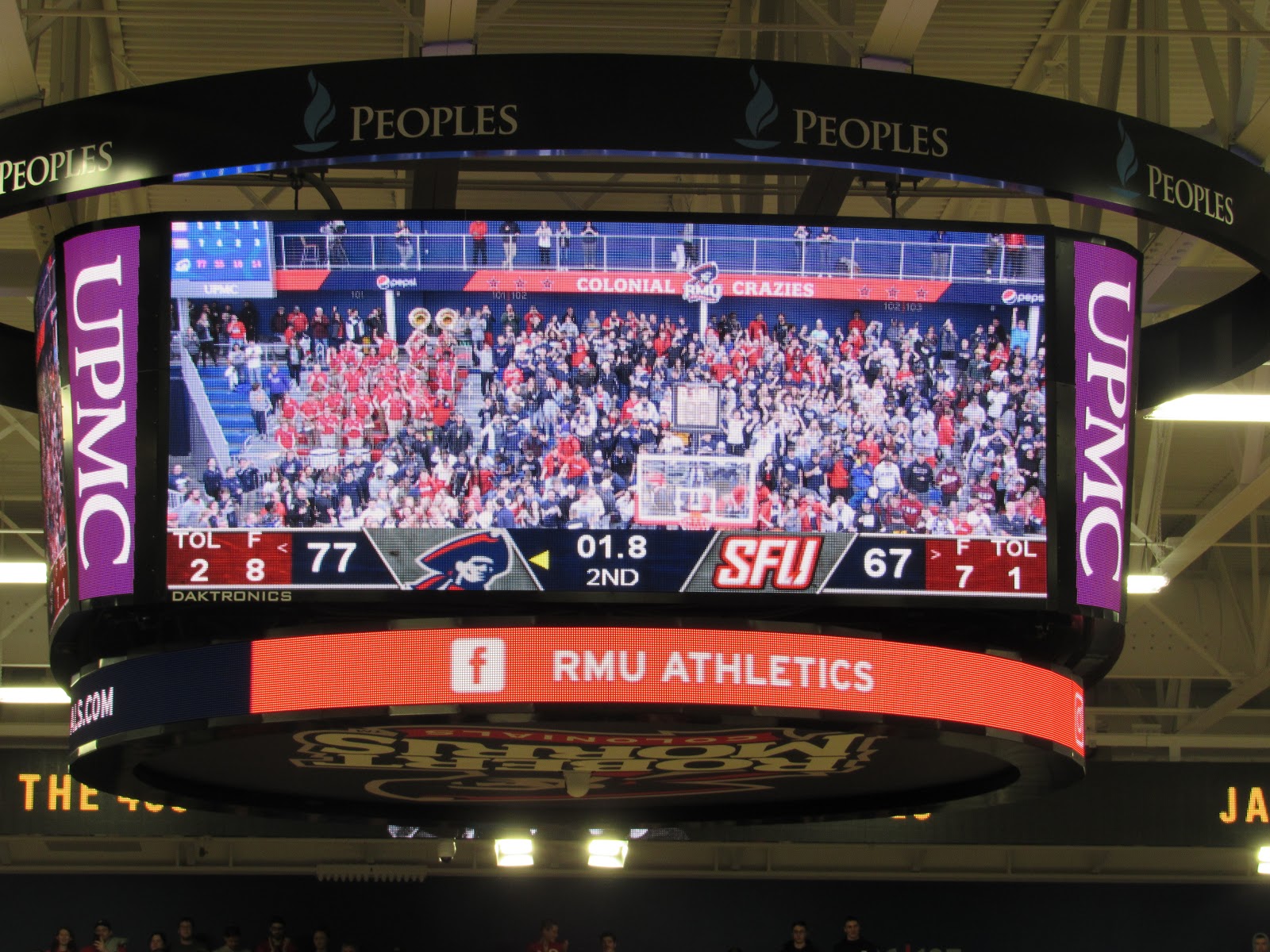
On more than one occasion over the last ten plus years of writing The Grandstander, I have used the expression "this is why you follow sports" when writing of one especially thrilling game or contest.  Last night Marilyn and I experienced such a night when we headed out to our alma mater, Robert Morris University, to watch the Colonials take on St. Francis in the Northeast Conference Men's Basketball Tournament Championship Game.


As is known by now, RMU won the game 77-67 (and the game wasn't as close as that score indicated) and secured an automatic bid to the NCAA Men's Basketball Tournament. They will no doubt be a very low seed and will lose convincingly to one of the NCAA blue bloods with a #1 or #2 seed, but no matter.  When you play in a mid-major conference like the NEC, last night is what you play for, and all of the elements were in place for just a terrific night.  It was the culmination of the first season the RMU's beautiful new Events Center, they were playing a team with whom they split the season series, and the place was sold out - 3,800 people and a packed student section.  The joint was loud and raucous and it was just a joyous event.

I have been lucky in my life.  I have been to NFL playoff games and World Series games and Stanley Cup Playoff games and NCAA playoff games.  I've been to US Opens and the Masters.  But last night a game between two small colleges in a minor league NCAA conference gave me a sporting moment as pleasurable and as fun as anything that I have ever attended.

It's why you follow sports.


Tuesday, March 10, 2020

Major League Soccer, aka the MLS


Yes, you read that headline correctly -  The Grandstander is about to offer a commentary on Professional Soccer in America, specifically, the MLS (Major League Soccer).  I will take no judgement as to the quality of play of the teams and players, because, of course, I have no qualifications to do so.  No, what is prompting this is a comment made by the commissioner of MLS, Don Garber, who recently said that in the next twenty years, MLS will have surpassed Major League Baseball in popularity.

Many people scoffed at this, but I did not.  If you read The Grandstander regularly, you know that I have made many posts regarding the need for MLB to make changes, to alter the pace of play and "get with it" to adapt to tastes of 21st century audiences who are finding baseball becoming more and more unwatchable as World Series games approach four hours in length (not to mention meaningless games played in August and September).  The cluelessness of both MLB Management and Players Union in their willingness to address these matters continues to contribute to the problem.  This will result in games being played before smaller and smaller crowds and having lesser and lesser interest among the public as the Baby Boom generation continues to age and, eventually, die off.  As an example, my older brother tells me that his four grandsons, who range in age from 18 to 25, can name you any number of soccer players in the English Premier League, but would be hard pressed to name a half dozen players from the Washington Nationals, the current World Series champions.

So, what about Mr. Garber's claim?  I went to Wikipedia (so we all know that this must be true, right?) to check on attendance figures for the MLS for its most recently completed season, 2019:

Total Attendance (24 teams, 408 games) - 8,676,109
Average Attendance per Game -21,305
Highest Average Attendance - Atlanta 52,510
Lowest Average Attendance - Chicago 12,324

In terms of Attendance As a Percentage of Capacity:
  • 100% or more - 6 teams
  • 90% to 99% - 3 teams
  • 80% to 89% - 7 teams
  • 70% to 79% - 5 teams
  • 60% to 69% - 3 teams
(Curiously, the three lowest Percent of Capacity teams are two teams in New York City and one team in Chicago.  Not sure what that tells us.)

Major League Baseball, by contrast, had teams whose average attendance ranged from 10,016 (Miami Marlins) to 49,066 (LA Dodgers).  The Dodgers played to an 87% capacity at Dodger Stadium last year; the Marlins at 27% capacity.  Some other figures of interest: Red Sox at 96% capacity, Yankees at 86% capacity, and, of local interest, the Pirates at 48% capacity (18,413/game).

I am sure that somewhere out there one can find a decennial breakdown of percentage of capacity for the 30 MLB teams.  I quit looking for it after awhile, and I didn't want to take the time of compiling this on a team-by-team basis.  Perhaps another time.

And just to carry this out a bit further, I did a comparison of National Hockey League attendance for the 2018-19 season.  average attendance ranged from 12,442 (NY Islanders) to 21,399 (Chicago Black Hawks).  In terms of percentage of capacity, here is how it broke down for the NHL:
  • 100% or more - 10 teams
  • 90% to 99% - 16 teams
  • 80% to 89% - 1 team
  • 70% to 79% - 4 teams
Locally, the Penguins averaged 18,565/game last year, good for 101% of capacity.

I'm too lazy to look up similar figures for the NBA.  Feel free to do so on your own.

Conclusions?  Well, I am not claiming to have made an authoritative, all-inclusive analysis of attendance trends all across major league sports in America, but I am willing to grant that the MLS Commissioner's statement cannot be dismissed out of hand.  There are lots and lots of other factors involved (eg, what are the MLS TV ratings compared to other sports?), and we all know that numbers can be sliced and diced ("figures lie and liars figure", right?) to come up with any conclusion that you might want to make, but one conclusion that I can make is that the MLS should probably be considered a major sport in America.  I won't be around in 2040 to see if Mr. Garber's prediction proves to be accurate, but I wouldn't bet against it.